
Wed, Oct 28 2026
AI-generated content has given us many surprises, allowing any ordinary person to create seemingly magnificent works in seconds. However, over time, more and more people are beginning to see the emptiness behind AI art. We cannot see Vermeer's delicate portrayal of tranquil life or Picasso's transition from realism to abstraction in AI's paintings. Recently, Vox wrote an article analyzing this phenomenon. Here are some excerpts from our report:
Lack of Depth and Meaning in AI Art: AI-generated content often appears hollow, uninteresting, and disposable, failing to move people. The article points out that while AI-generated works may look like human creations on the surface, they lack true artistic depth and emotional connection.
Threat to Professional Creativity: The rise of AI tools poses a threat to professionals who rely on artistic creation for their livelihood. AI-generated works are impacting the art market, causing many artists to worry about their works being imitated by AI, leading to loss of income and job security.
Technical Limitations and Flaws: Currently, AI generators like DALL-E and Midjourney still rely on large amounts of data for training and perform poorly when dealing with complex and uncommon prompts. For example, AI still has obvious flaws when generating images like "an astronaut riding a horse," exhibiting a "strange and flashy" feeling.
Economic Impact of AI Art: AI-generated artworks may make brands appear to lack budget and creativity, giving a cheap impression. At the same time, AI can be used for various fraudulent activities, such as deepfakes and phishing attacks, causing negative impacts on society.
Future Coexistence of Art and AI: Although the use of AI in the creative industry has raised many concerns, it may also prompt industry transformation and adaptation. The article suggests that more live events and real-person performances may become mainstream in the creative industry in the future. AI technology might be used for new art forms and expressions, driving the development of art.
Original link: https://www.vox.com/culture/351041/ai-art-chatgpt-dall-e-sora-suno-human-creativity
Original author: Rebecca Jennings
For a long time, artificial intelligence has been praised as the great "equalizer" of creativity, ultimately putting the ability to create various forms of art into the hands of tech enthusiasts. Even if you are not a creative person, that's okay. DALL-E can convert text prompts into images. Its chief researcher said, "DALL-E is aimed at those who do not necessarily consider themselves artists. We developed this tool to truly democratize image creation."
Sam Altman, founder of OpenAI, wrote in his book that one day, generative AI will account for 95% of the work done by companies hiring creative professionals: "All of this is free, instant, and nearly perfect. Images, videos, event ideas? No problem." Or, as the founder of another AI startup put it, "Many people in the world have 'creative constipation,' and we want to help them 'poop rainbows.'"
But for real artists and anyone who cares deeply about the words, images, and sounds we face every day, this is a problem. Any promise of disruption comes with reasonable concerns: that its replacement may be worse. This is true for creative professionals who rely on artistic creation for their livelihood, for those who enjoy reading good articles, appreciate thoughtful visual art, and watch movies not just for entertainment but because good movies can bring surprises. Should we take seriously the artistic vision of those who see "pooping rainbows" as the pinnacle of creativity?
So far, the reason AI has not replaced human creation is that consumer-grade AI tools are not very good at art. Generative AI creates content by recognizing patterns in data and using statistics to determine what the prompter wants. But if the meaning of art goes beyond the images or words that make it up or the money it earns, then what is the use of a combination of metadata detached from its original context?
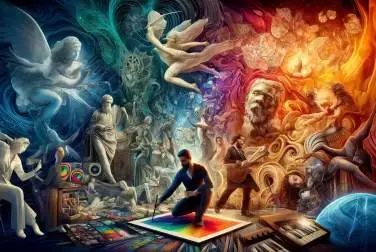
An image generated by DALL-E based on the prompt "Use an image to show what art is." Image source: DALL-E
ChatGPT can produce text, while Stable Diffusion, Midjourney, Lensa, and DALL-E can generate images. Suno can create songs, and Runway and Sora can turn text into videos. These generators can produce text, music, or visual effects that appear human-made through training on a vast amount of human works. However, upon closer inspection, it becomes evident that much of this content is hollow, uninteresting, and disposable. As a former journalist now working at Meta put it, "Not a single AI-generated creative work has truly impressed me... they all flash by and then vanish without a trace."
What would happen if, one day, future AI tools could create novels people genuinely want to read, songs they can't get enough of, or movies that audiences are willing to pay big bucks to watch in theaters? Or perhaps a better question is: do the people who possess this technology even understand why we create and appreciate art in the first place?
Why does AI art seem so cheap? For years, visual artists have been using machine learning, but they usually do so in a way that reflects the artist's process and ideas, rather than the machine's. Anna Ridler, a conceptual artist, uses a machine learning method called Generative Adversarial Networks (GANs), which can be trained solely on the images she provides. Her works are not made with those simple text-to-image generators like Midjourney and DALL-E. The tools she uses are trained on billions of images scoured from the internet. "Conceptually, it’s hard to do something interesting with them because they are hidden behind an API. It’s a black box," she said, referring to the proprietary (rather than open-source) generators used by these companies, which hinder true experimentation.
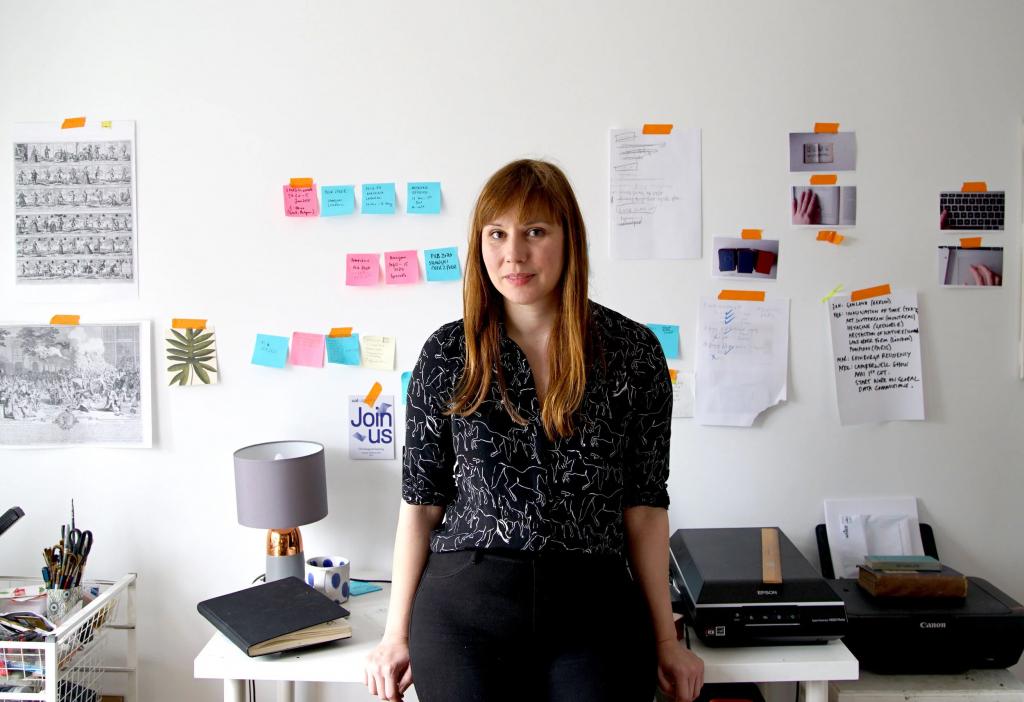
Anna Ridler. Image credit: Digital Art Museum.
In contrast, the works produced by these generators often appear bizarre, overly polished, and typically exhibit issues both obvious and subtle. It is well known that generative AI's reliance on data makes it incapable of accurately depicting human hands. As psychologist and AI critic Gary Marcus pointed out, it also struggles with prompts that are impossible within its data set, such as "a horse riding an astronaut," which still seems to be the exclusive domain of human imagination (even the latest AI models will always give you an image of an astronaut riding a horse).
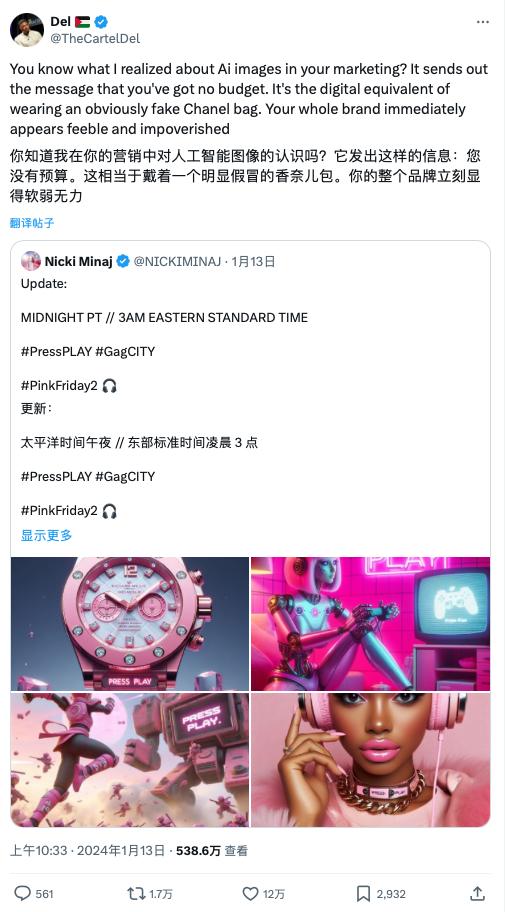
"These pictures have a strange and flashy feeling, and they will have a timestamp indicating 'this is an image from the mid-2020s'," said Ridler. "The more you play with these things, the more you realize how difficult it is to get genuinely interesting and original content from them." However, what AI excels at is flooding the internet with mediocre, ephemeral art. "Do you know what I realized when you use AI images in your marketing? It conveys that you are under-budgeted. It's like carrying an obviously fake Chanel bag. Your entire brand tone immediately appears weak," artist Del Walker wrote on the X platform.
The same is true for text generators. Last year, Neil Clarke, the founder of the science fiction magazine Clarkesworld, shut down submissions after discovering that nearly half of the submissions were generated by ChatGPT. "When we encountered this situation last year, I told everyone that they were worse than any human author we had ever seen. And after one update, they were on par with the worst authors we had encountered," he said. "As a statistical model, it can only predict the next most likely word, so it doesn't really understand what it is writing. And to tell a good story, understanding is essential."
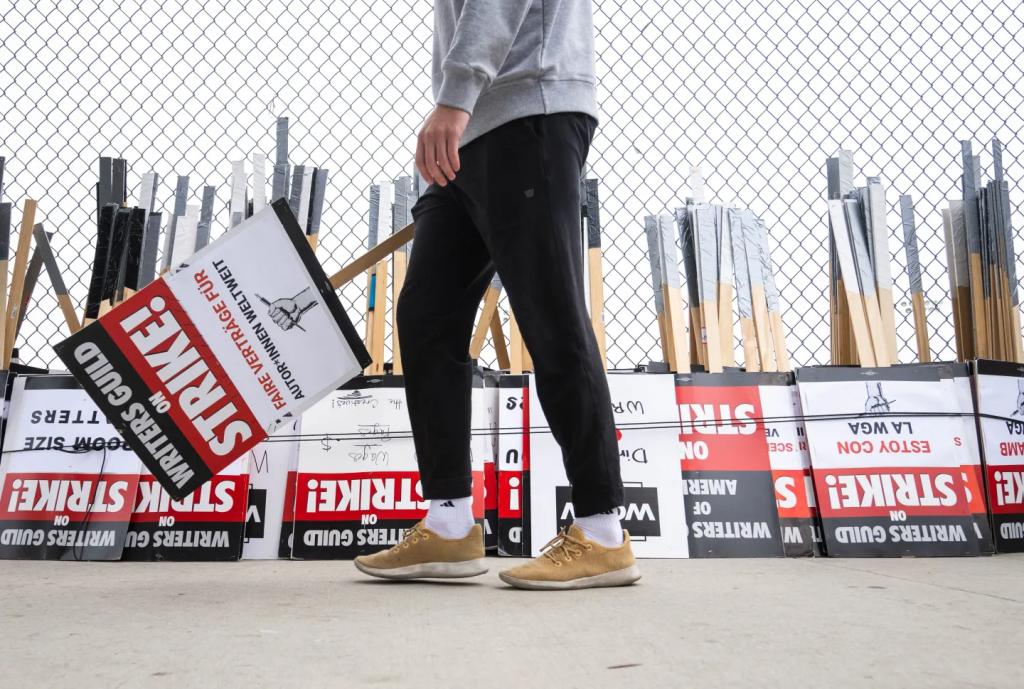
Excellent stories often work on multiple levels—they contain subtext and meaning that a statistical model might not grasp just from data alone. Instead, Clarke said, AI-generated stories, even if grammatically perfect, are bland and unremarkable. "Now, you can have GPT-4 generate something that looks like a complete script: it will have 120 pages, characters whose names are consistent throughout, and dialogue similar to what you'd find in movies," said John August of the Writers Guild of America (WGA), which secured significant protections against AI last September. "Does it really make sense? I don't know. It might be better than the worst script you've ever read, but that's a very low bar. I think it's still a long way from being something you'd want to read or watch."
The longest strike in Hollywood history is coming to an end. Photo credit: Los Angeles Daily News
AI has already found some applications in films, such as making actors' lip movements match dubbed foreign languages or creating background scenes and characters. More controversially, AI has also been used in documentaries: the 2021 film "Roadrunner: A Film About Anthony Bourdain" used AI to make a fake Bourdain say three sentences, and the 2022 film "The Andy Warhol Diaries" employed similar techniques. In April of this year, leaders of the Archival Producers Alliance drafted a list of best practices for the use of AI in news films, including allowing AI to repair or restore images but warning that the use of generative AI to create new material should be considered carefully.
AI supporters are touting a future where personalized entertainment is available at the touch of a button—a future that remains distant, despite no consensus on its desirability. "Imagine you could ask an AI to generate a movie with specific actors, plots, and locations, all tailored to your personal preferences. This would allow individuals to create their own movies from scratch for their own viewing, eliminating the need for actors and the entire industry around filming," an AI industry organization quipped, showcasing video samples generated by Sora.
Marvel filmmaker Joe Russo expressed a similar viewpoint in an interview, saying, "You could walk into your house and tell the AI on your streaming platform, 'Hey, I want a movie starring a photorealistic version of me and Marilyn Monroe. I want it to be a romantic comedy because I've had a rough day,' and it will render a very realistic story and dialogue using your voice. In an instant, you have a 90-minute romantic comedy starring you."
Of course, the next generation of AI tools could potentially make leaps forward, turning this fantasy into reality. However, this inevitably raises a question: Do most people want, or will they want in the future, the art they consume to be a "very competent" highly personalized romantic comedy?
This doesn't mean that AI won't change the creative industry. Despite sounding dystopian (especially since, as any woman on the internet knows, this technology is being used to create non-consensual pornographic images and videos), we actually have a good precedent. Just as AI aims to "democratize" art creation, the creative industry built on social media aims to do the same: by "empowering" individuals to create their own content and providing a platform where their work can truly be seen, circumventing the traditional media gatekeepers.
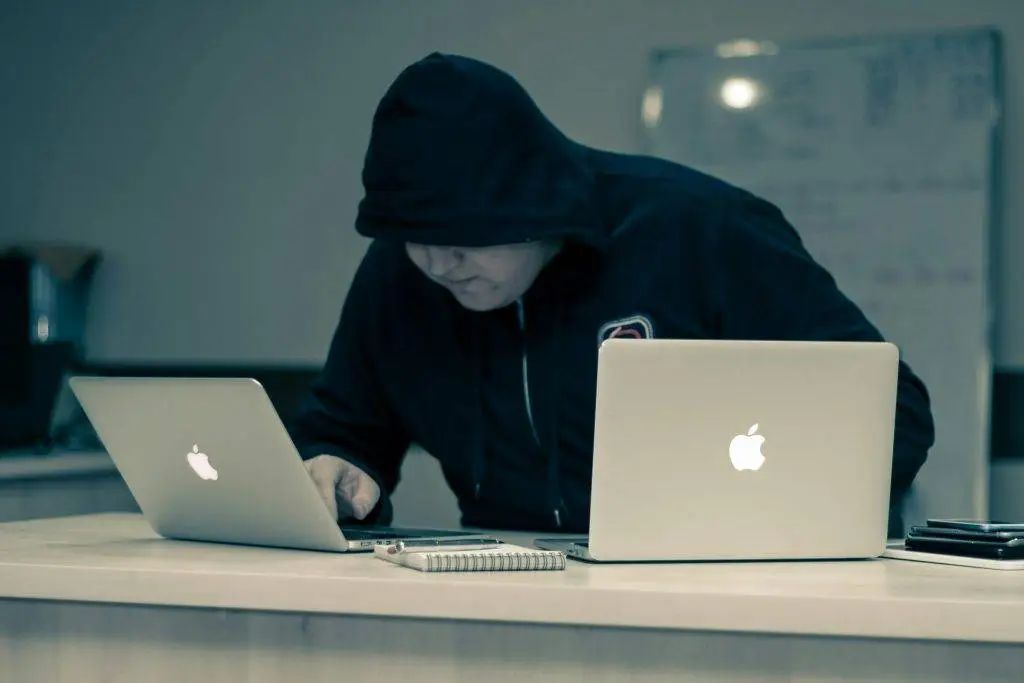
There are clear pros and cons to this. While AI can help creators who lack sufficient funds or technical skills by providing new tools to create visual and sound effects, AI is equally useful, if not more so, for fraudulent activities such as massive, unimaginable phone scams, deepfakes, and phishing attacks.
Concerns are growing about the disruptive potential of AI. Image credit: Unsplash
Ryan Broderick often discusses the impact of AI on culture in his newsletter, "Garbage Day." He says, "What I worry about is that we are rapidly heading towards a world where the wealthy can read text written by humans, while the poor read text written by machines." Broderick compares this situation to what has already happened on the internet in many parts of the world, where the wealthy can subscribe to newspapers and magazines written by professionals, while the working class often consumes news on social media, where the lowest-quality content tends to get the most attention.
The key point is that social media may have broken the traditional media's control, providing more people with a platform to showcase their art, but it has not increased the number of creators who can make a living from it—in many ways, it has done the opposite. The real winners, both in the past and now, are the owners of these platforms, just as the real winners with AI will be the founders who market their products to corporate executives to replace human workers.
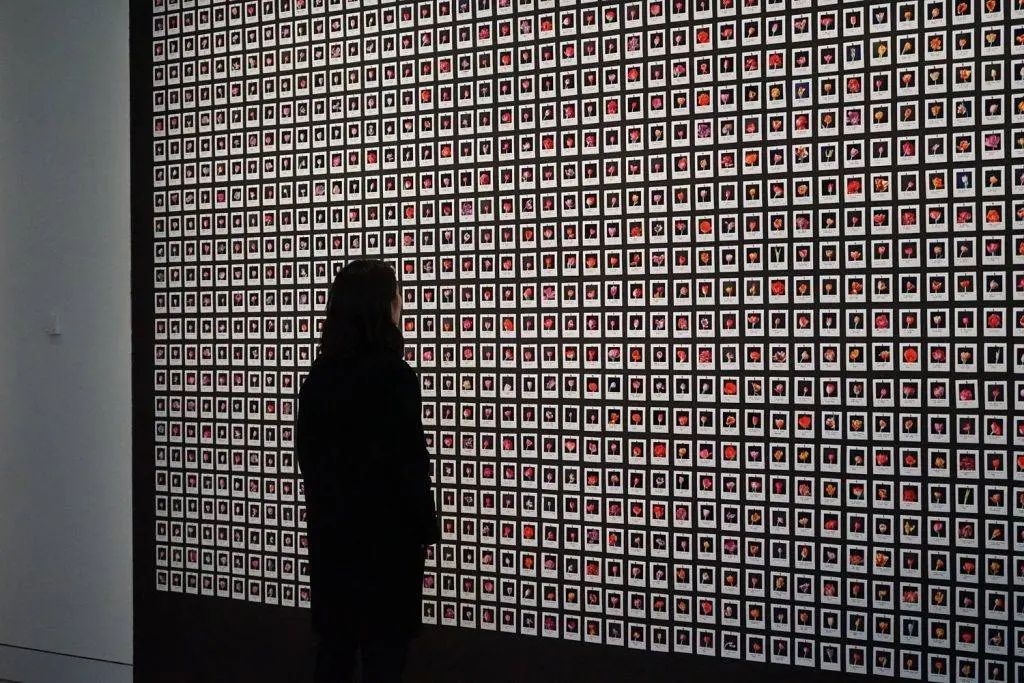
Anna Ridler's "Myriad" is an installation composed of thousands of tulip photos, which she later used as a database for other projects. She wrote, "By choosing to make the database an artwork, it draws attention to the skill, labor, and time required to construct it, while also helping to reveal the human factors usually hidden by algorithmic processes." (Image source: Vox)
While AI cannot create excellent art without the guidance of human geniuses, that doesn't mean it won't pose a survival threat to creative workers. Over the past few years, artists have been horrified to see their works stolen and used to train AI models, feeling as though they are being replaced in real-time. A novelist using the AI writing tool Sudowrite said, "It makes you start to wonder, if a computer can mimic me, am I still talented?"
Young people are reconsidering whether to enter the arts. Last October, at a Federal Trade Commission (FTC) roundtable on the impact of generative AI on the creative industry, illustrator Steven Zapata said, "If potential clients can easily find an AI knockoff of our work for free online when they search our name, it will be devastating to the individual artist's career and the art industry as a whole."
Cory Doctorow, known for his science fiction and tech commentary, believes that any discussion about AI art should center around the question: "How can we minimize the possibility that an artist earns 1𝑙𝑒𝑠𝑠𝑏𝑒𝑐𝑎𝑢𝑠𝑒𝑠𝑜𝑚𝑒𝑡𝑒𝑐ℎ−𝑠𝑎𝑣𝑣𝑦𝑔𝑢𝑦𝑒𝑎𝑟𝑛𝑠1 more?"
How should we view the "threat" of AI to art? While we should take the labor impact of AI seriously—not to mention the significant ethical and environmental impacts—Doctorow argues that we must stop overhyping AI's capabilities. "Just as pretending 'Facebook ads are so good they can brainwash you into joining QAnon' is a good way to help Facebook sell ads, when AI salespeople say, 'I don't know if you've heard my criticisms, but it turns out I have the most powerful tool ever, and it's going to end the world. Don't you want to buy some from me?' it’s the same thing."
This is how AI salespeople view art: as a commodity to be bought and sold, rather than something to be made or enjoyed. In 2010, in an article about "The Social Network," Zadie Smith pointed out that the experience of using Facebook is essentially the experience of existing inside Mark Zuckerberg's mind. Everything is tailored to suit him: "The choice of blue as the theme color is because Zuckerberg is red-green colorblind... the poke feature exists because that's what a shy boy does to a girl he can't talk to. The personal trivia page exists because Mark Zuckerberg thinks exchanging personal trivia constitutes 'friendship.'" she wrote.
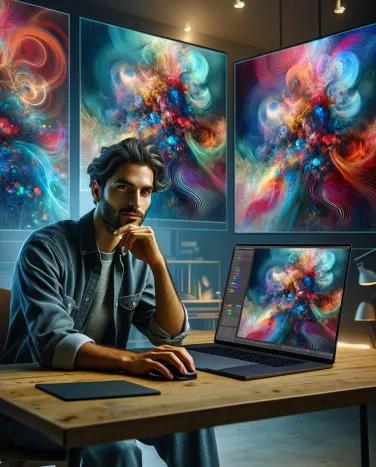
An image generated with the prompt "portrait of an artist creating beautiful art using AI." Image source: DALL-E.
Why do millions (now billions) choose to live this way instead of another? Just as we should question whether using a tool created by a sophomore focused on control and appeasement is the best way to connect with friends, we should also question why we should trust AI executives and their supporters to decide anything related to creativity.
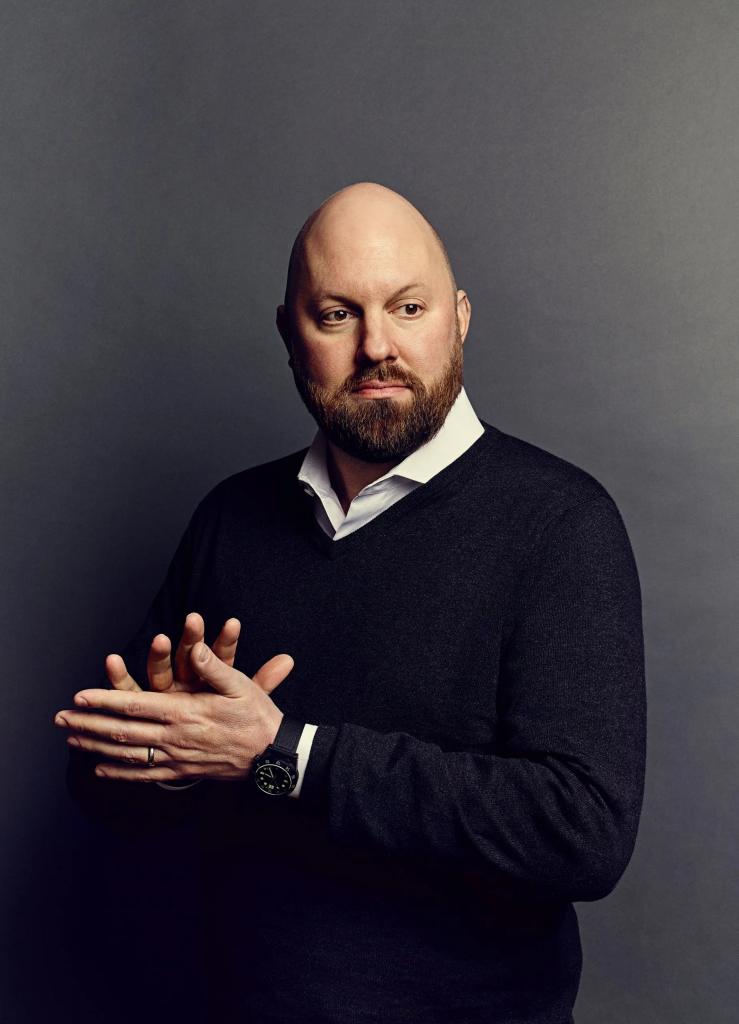
One of the most absurd pieces published last year was Marc Andreessen's "Techno-Optimist Manifesto." In this work, the wealthy venture capitalist complains that he and people like him lack cultural power compared to the "all-knowing senior experts in ivory towers." We can reasonably infer that these ideological enemies are ethicists, scholars, and union leaders—people who, under his "progressive view" (i.e., free markets, zero regulation, and unlimited investment in technological advancement regardless of what these technologies are actually used for), might care about the well-being of ordinary people.
One slightly comical element of the "Techno-Optimist Manifesto" is the author's interest in art, which evidently does not extend beyond the familiarity of a typical ninth grader with literature (including "The Hero's Journey," Orwell, and "Harry Potter"). In a list of "techno-optimist patron saints," Andreessen names dozens of individuals, most of whom are free-market economists, with only one visual artist: Warhol.
A billionaire venture capitalist with billions of dollars—Marc Andreessen. Image source: The New Yorker.
On X, the platform run by another out-of-touch billionaire, AI proponents celebrate a world finally free from human creators, or even humanity itself. "That's it. The era of OnlyFans is over," commented a tech critic under a video of an AI-animated dancer. "Clearly, AI will replace the online companionship/modeling industry," another commented. "Make money on OnlyFans while you still can," advised another.
Similarly, those who believe AI will "replace Hollywood" or the music and publishing industries lack curiosity about why we consume art in the first place. For example, try asking Google's new AI summary feature, "Why do people like art?" It will tell you, "Viewing art can release dopamine." People love great art not because of the chemicals it releases, but because it challenges us, comforts us, confounds us, explores us, attacks us, inspires us, and uplifts us. Great art is a miracle, witnessing it feels akin to experiencing divinity and the human condition, and it reminds us that the two may be one and the same.
The widespread comparison of AI to a cult is no coincidence; its followers have an almost religious fervor, believing that one day AI will become omnipotent. But if you look at a piece of art and see only content, or look at a photo of a beautiful woman and see only a JPG file, then that is all you will get from it.
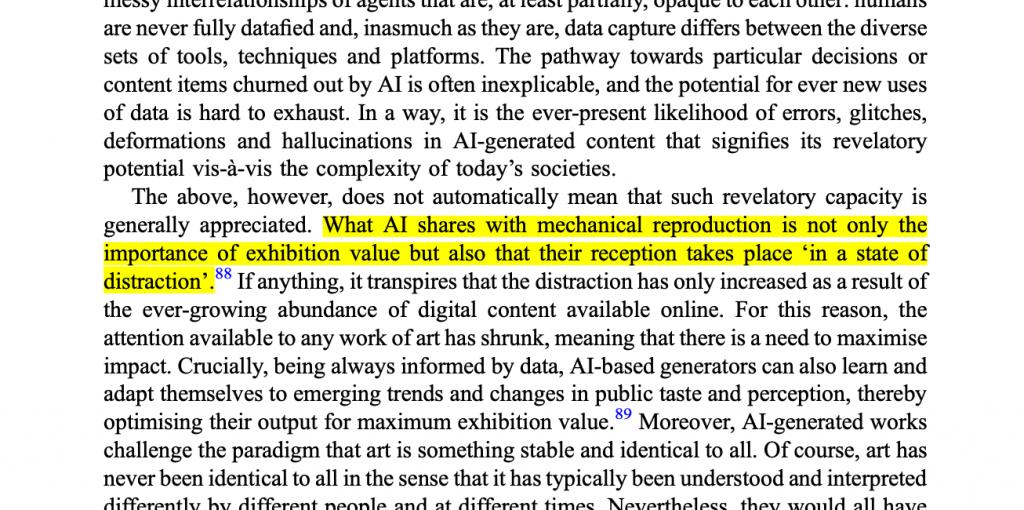
Cory Doctorow is willing to concede that AI-generated works may one day be regarded as an art form, just as sampling went from being despised to becoming a common and celebrated practice in the music industry. Media theorist Ignas Kalpokas has written that AI art "has a revelatory quality, making the collective unconscious of contemporary society—its data patterns—visible, in a manner consistent with Walter Benjamin's view of the psychoanalytic capabilities of photography and film." However, he believes that the more AI-generated content there is, the more likely audiences are to experience it "in a state of distraction."
People tend to experience AI content "in a state of distraction." Image source: Ignas Kalpokas.
The future of art and entertainment is likely to involve individuals requesting their personal AI to provide them with music, movies, or books, creating them with just a click. If this mode of entertainment becomes the norm, the creative industry will adapt as it has for over a century. "The history of the professional creative industry is one of competition—television competing with film, radio competing with television," explained AI artist and digital culture theorist Lev Manovich. "Perhaps the industry will become more focused on live events, and human performances will become more valuable. If machines can create Hollywood-level media, then the industry will have to offer something else. Some people might lose their jobs, but new ones will be created."
I wondered what could attract someone like science fiction magazine editor Neil Clarke to truly publish AI-generated novels using existing technology. His answer encapsulated all the doubts many in the creative industry have about the idea that AI can do the same work as artists. "I will accept an AI story when the AI decides, of its own volition, to write a story and chooses us as the place it wants to publish it. If aliens appeared on Earth, I wouldn't refuse them either. At that point, it will be a new form of life," Clarke said. "But that's a plot from science fiction. If I see it in my lifetime, it will be a wonderful thing, but I'm not holding my breath waiting for it."
Comments 0